Skip to content
Marketing Factory Digital GmbH
Contact
Logo Marketing Factory Digital GmbH
  • Agency
    • What's new
    • About us
    • History
  • Services
    • Consulting, Analysis and Strategy
    • Programming and Development
      • Interface Development
      • PIM/ERP Links
      • Custom Development
      • Seamless CMS Integration
    • Agency Retainer
    • Hosting and Maintenance
      • Cloud Strategies
      • Hosting Partners of Marketing Factory
    • Services with Third Parties
  • Technology
    • TYPO3 Agency Marketing Factory
      • TYPO3 Upgrade vs. TYPO3 Relaunch
      • Current TYPO3 Versions: v12 ELTS, v13, v13
      • The TYPO3 Lifecycle
      • Upgrading from TYPO3 v12 to v14
      • Our TYPO3 Extensions
    • Shopware
    • IT Security
      • DDoS Protection
      • Continuous Upgrading
      • Privacy First
    • Tech Stack
      • Commitment to Open Source
      • Technology Selection
      • PHP Ecosystem
      • Containerisation & Clustering
      • Content Delivery Networks
      • Search Technologies
  • References
    • Projects
    • Clients
      • Client List
    • Screenshot of the homepage of the new Maxion Wheels websiteNEW: Relaunch of the corporate website of Maxion Wheels
  • Community
    • Community Initiatives
  • Blog
  • Contact
  • Deutsch
  • English

You are here:

  1. Blog
  2. When a Website Has to Go Offline: Our Approach to a Fallback Site
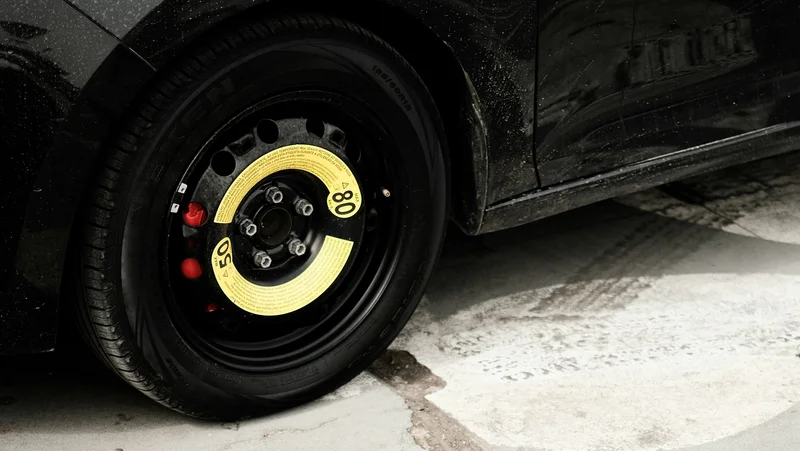
A close-up of a black spare car wheel with a yellow center ring displaying the number 08. The car is parked on a cracked concrete surface with faded white painted markings and a yellow line in the foreground.
  • Security
  • Hosting
  • TYPO3
13.11.2026

When a Website Has to Go Offline: Our Approach to a Fallback Site


What happens when a client's website has to be shut down for security reasons?

A website that runs perfectly, yet nobody can reach it. Sounds like a riddle, but that's exactly what happened in October 2026. A critical security vulnerability in PHP led numerous hosting providers to take their systems offline as a precaution. Some of our clients were affected as well: their websites were unavailable for a while, even though neither the applications nor the servers themselves had failed.

Situations like this can't always be prevented. And we expect to see them more often in the future.

So we came up with a way to keep at least a pared-down version of the website online when that happens.
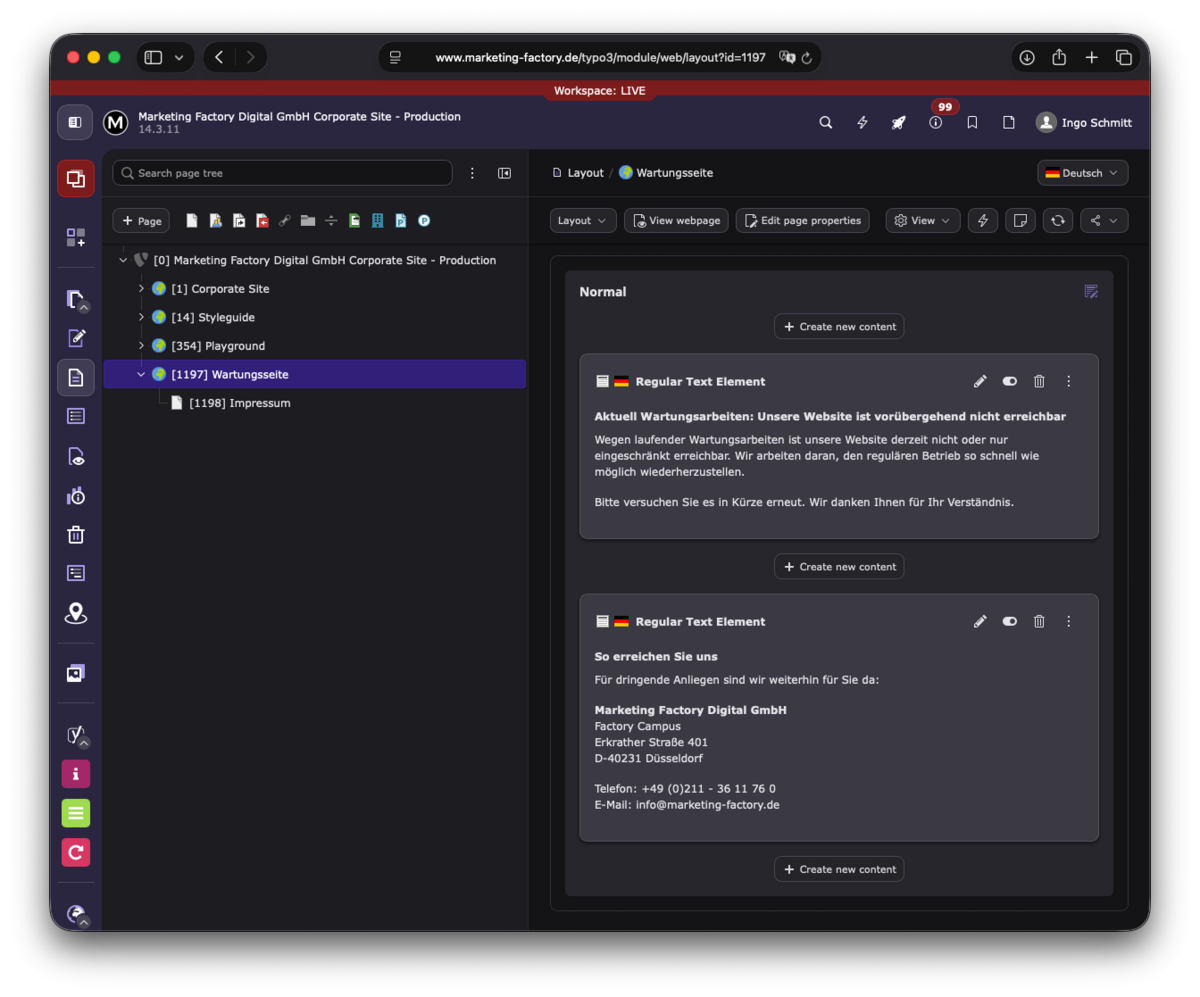
Show larger version for: Screenshot einer CMS-Bearbeitungsansicht. Links ist die Seitenstruktur mit der aktiven 'Wartungsseite' markiert. Im Hauptbereich werden Textelemente angezeigt, die über Wartungsarbeiten informieren und Kontaktdaten für die Marketing Factory Digital GmbH bereitstellen.

A second, independent website

We've deliberately kept our approach simple. Within the existing TYPO3 installation, we set up a separate page tree where clients can maintain a stripped-down version of their website. That might be a single page or multiple pages containing key information and contact details.

We regularly export this content as a static website and host it on independent infrastructure with a different provider, such as Amazon S3 or another static hosting service.

The result is a version of the website without search or forms. It needs neither PHP nor a database, and it keeps working even when the main hosting infrastructure is down.

Automatic failover via the CDN

Under normal circumstances, visitors never notice this second website. They simply get the regular site, as usual.

The content delivery network (CDN) in front of the site monitors the availability of the main infrastructure. If the main infrastructure becomes unavailable, traffic is automatically switched over to the static emergency site.

Visitors stay on the same domain and can still access the information that's been prepared for them.

We also want temporary emergency operation to have as little impact as possible on how search engines index the regular website. That's why the switchover uses the appropriate HTTP status codes.

Not a full copy, and that's intentional

The goal isn't to run a fully redundant copy of the entire website. That would be far more complex technically, and for many of our clients it simply isn't necessary.

The point is to stay reachable during an outage and keep important information available. Features like online shops, forms or customer portals are intentionally left out in emergency mode. This keeps the emergency site lean and independent of the underlying infrastructure.

Our emergency website should not be confused with a dark site designed for corporate crisis communication. An accident, a safety incident at a production facility or any other corporate crisis brings additional requirements for content, approvals and communication processes. We plan solutions like that individually, together with each client.

An extra safety net for our clients

We've developed this approach as a standard solution for the TYPO3 websites we look after. Content is still managed in TYPO3, while delivery runs independently of the main infrastructure.

So even if the main infrastructure goes down completely, the most important information stays available.

Ingo Schmitt

Fluent in TypoScript, php and sql; knows perl and bash and has very basic knowledge in java. Joined in 1996 and now serves as Managing Director responsible for development, operation and hosting of our products. Articles in this blog cover technical and sustainable topics. Involved with TYPO3 as chairman of the Business Control Committee (BCC) and organizes the annual TYPO3Camp RheinRuhr.

More posts by this author

Get blog posts as RSS feed

Related blog posts

  • When Bot Traffic Suddenly Multiplies by a Thousand
  • How we automate container updates on mittwald
  • We’re Retiring beuser_iprange
  • Check the container! – Solr is moving

Please feel free to share this article.


Comments

No comments yet.

Write a comment.

I have been informed that the processing of my data is on a voluntary basis and that I can refuse my consent without detrimental consequences for me or withdraw my consent at any time to Marketing Factory Digital GmbH by mail (Erkrather Straße 401, D-40231 Düsseldorf) or e-mail (info@marketing-factory.de).

I understand that the above data will be stored for as long as I wish to be contacted by Marketing Factory. After my revocation my data will be deleted. Further storage may take place in individual cases if this is required by law.

  • Data privacy policy
  • Legal notice

© Marketing Factory Digital GmbH

Alternative text for images is partially generated by AI

Picture Credits
  1. Picture: Oriel Mizrahi / License: Unsplash License
  2. "Screenshot Wartungsseite": © Ingo Schmitt / Marketing Factory Digital GmbH