
Finding the right prefab home with an AI chatbot
With bau-welt.de, CPZ runs one of the largest manufacturer-independent databases of prefab homes in the German-speaking world. Visitors can browse houses through the site search, categories, manufacturer pages and a faceted search with fixed criteria such as living space, construction method or roof shape.
With so much choice, the hard part isn't finding houses. It's narrowing them down. Many of the requirements that really matter, like a certain feel, a flexible floor plan, a family-friendly layout or a preferred architectural style, don't fit neatly into filters. They're much easier to describe in your own words.
The information was already there, much of it in the manufacturers’ detailed house descriptions. What was missing was a way to match it against what each visitor is looking for and turn that into a curated shortlist.
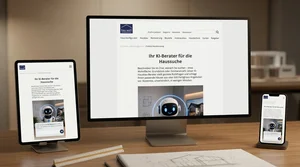
The goal was an AI-powered home advisor that uses existing data and editorial expertise to help visitors find suitable homes through a conversation. Visitors describe their needs and preferences in plain language and are guided to suitable houses through a conversation.
In a next phase, the advisor will also connect prospective buyers directly with the right manufacturers, generating qualified leads for them.
| Client | CPZ (City-Post magazine publisher) |
|---|---|
Project duration | 2026 |
The AI home advisor lets us make the knowledge in our house data and editorial content accessible in a completely new way. Working with Marketing Factory, we quickly arrived at an approach that worked, and we were able to refine it with real users right from the start.
Discover the project from the perspective of:
From browsing listings to a digital consultation
An AI advisor instead of a database relaunch
The original plan was to relaunch the existing house database. Instead, the AI home advisor adds a new advisory layer on top of the data and structures already in place.
Extending the classic faceted search would have taken more than technical changes. Every existing house listing would also have needed editorial classification and additional attributes, and that effort would have continued with every new or updated house.
The home advisor works with the existing descriptions instead. Any additional attributes needed for the recommendations are extracted from that content automatically using AI. This makes existing knowledge searchable without adding yet another editorial maintenance process.
The result is a new user experience, without rebuilding the house database or manually classifying the entire inventory on an ongoing basis.
Conversation as an additional way to search
The home advisor adds a conversational layer to the existing search options on bau-welt.de. Visitors describe in their own words what they're looking for and what matters to them in a home.
From there, the advisor starts a dialogue and asks follow-up questions whenever more information would help. It explains technical terms and decision criteria and helps visitors understand which features are relevant to their own building project. This is especially useful when people know what they want but don't yet know the right terms or house features to look for.
It then matches the visitor's input against the available house information and puts together a selection that fits their individual requirements, including wishes that are hard to express as fixed search criteria.
House hunting becomes more personal and intuitive. Alongside the classic search options, visitors now get digital advice tailored to their individual needs.
Editorial knowledge straight from the CMS
On top of the house data, the editorial team can feed the home advisor its own expertise, for example on frequently asked questions, new construction methods or other topics around building a home.
This doesn't require another system or a new editorial workflow. Content is managed in TYPO3 as usual, whether it's written specifically for the advisor or already exists on the site. A page-level flag determines whether a page is added to the advisor's knowledge base.
Editors keep working exclusively in the CMS they know and decide for themselves what the advisor should learn. New or updated content is then added to the knowledge base automatically.
From conversations to measurable insights
The home advisor also sheds new light on what prospective buyers are actually interested in. A weekly business report shows which houses and manufacturers were recommended in conversations.
It also reveals whether the advice actually works and leads to suitable recommendations. Conversations are evaluated automatically on a regular basis, providing a solid basis for continuously improving the advisor based on real-world usage.
This adds value for CPZ beyond the advice itself. For the first time, CPZ can see which houses and manufacturers actually become relevant in real conversations with prospective buyers, giving CPZ new insights into what prospective buyers want and need.
A fast start instead of months of planning
To test the idea under real conditions as early as possible, we moved quickly from the initial concept to a working prototype. Within just a few days, we had a demo that made it possible to discuss the value proposition, technical feasibility and next steps based on something tangible.
That turned an idea into something tangible very quickly and laid the groundwork for developing it into the production-ready home advisor.
From TYPO3 content to an AI-powered advisory system
Structured and unstructured data from TYPO3 and Solr
The home advisor's data is managed in TYPO3 and served through the existing Solr search. This way, the advisor builds on the data structure and search infrastructure bau-welt.de already has, with no separate dataset to maintain in parallel.
Using the existing Solr index has another advantage: the content is already prepared for search. The advisor gets the relevant text without having to clean up HTML or filter out recurring layout elements and other boilerplate.
Editorial control in TYPO3 stays intact, too. Hidden and scheduled content is already taken into account when the Solr index is built, so we didn't have to implement that logic a second time for the knowledge base. Anything that hasn't been published yet or is no longer visible won't find its way into the advisor as supposedly current knowledge.
The house data combines classic structured fields with detailed descriptions. Much of the information that matters for good advice isn't stored in individual fields but in the running text.
That's why the import into the knowledge base goes beyond the structured data from Solr. An AI model also analyzes the descriptions and extracts features that are relevant for the advice later on. Information that used to be buried in a description is now available to the advisor in structured form as well.
House listings and editorial content are synced with the knowledge base automatically on a regular schedule. A page-level flag in TYPO3 controls which editorial pages the advisor uses as knowledge, so new and updated content becomes available automatically.
TYPO3 remains the single source of truth for editorial content. Solr provides the content in a search-ready form, with TYPO3 visibility rules already applied, and we build the AI-powered knowledge base on top of it. The knowledge base itself needs no manual maintenance.
Combining semantic and structured search
For semantic search, we use Qdrant as a vector database. The house listings are indexed there and can be searched by how closely their content matches the meaning of a request.
This works especially well for open-ended requirements. A request like "We're looking for a modern house for a family of four with lots of natural light and a flexible floor plan" doesn't have to be broken down into individual search filters first. The advisor can find suitable houses based on the existing descriptions and the additionally extracted features.
That said, semantic similarity isn't the right answer to every question. When someone asks specifically for houses from a particular manufacturer, the manufacturer's name shouldn't be interpreted semantically. For requests like this, the agent also has structured access to the house data.
Depending on the question, the advisor decides whether a semantic or a structured search is the better fit. This lets it reliably handle both open-ended descriptions and specific questions about manufacturers or individual houses within the same conversation.
Automated workflows with an AI agent in n8n
We built the home advisor's workflows in n8n. At the core is an AI agent that processes each request and, based on the conversation so far, decides which information and tools it needs. It can run semantic searches in the knowledge base, query the house data directly and draw on the expertise maintained by the editorial team. It then uses what it finds to put together the right answer for the user.
n8n handles more than the interaction with the language model. Data syncing and preparation, building the knowledge base and other operational processes also run as automated workflows.
This keeps individual tasks separate, so each one can be developed, monitored and extended independently.
Updating the knowledge base with zero downtime
Every regular sync rebuilds the knowledge base. If we worked directly on the live dataset, searches could return incomplete or inconsistent results while an update is running.
That's why we use a blue-green approach. Qdrant holds two versions of the knowledge base, and the home advisor always accesses the currently active one through an alias.
New and updated content is first loaded into the inactive version and fully processed there. Only once the build has completed successfully does the alias switch over to the new version. The switch itself is atomic.
Search stays available throughout every update and always works with a fully built dataset.
A conversation, not a string of questions
The home advisor is deliberately designed to hold a real conversation rather than just answer a series of isolated questions. Requirements and wishes can evolve, become more specific or change entirely along the way.
To support this, the advisor keeps track of the conversation history within the current session. Requirements and preferences mentioned earlier stay available to the agent for follow-up questions.
The same goes for houses it has already suggested. If a user asks for more options, the advisor can provide additional suggestions without asking for the requirements again or repeating houses it has already shown.
Protection against prompt injection and unwanted content
A publicly accessible AI advisor has to cope with users trying to get around the system's rules or use the chat for something else entirely.
That's why user input is checked before it ever reaches the actual AI agent. An upstream check screens input for potential prompt injection attempts as well as inappropriate or off-topic content, and can intercept suspicious requests before they enter the advisory workflow.
This reduces the risk of carefully crafted input steering the advisor away from its intended purpose.
Quality assurance and reporting
With an AI-based advisor, monitoring technical availability isn't enough. What matters just as much is whether conversations work and actually lead to useful house recommendations.
That's why all conversations are evaluated automatically with AI every day. Among other things, the evaluation checks whether a conversation resulted in a successful recommendation. Unusually long response times are detected and flagged in the report as well.
In addition, a business report analyzes which houses and manufacturers the advisor actually recommended. This makes the outcomes of the advice traceable, not just its technical and content quality.
So the home advisor does more than answer users' questions. The evaluation also provides a basis for continuously assessing the quality of the advice and for learning which recommendations it actually makes.
Hosted in Germany, open-source AI models, transparent costs
All components of the home advisor run on hosting infrastructure operated in Germany. That includes workflow orchestration with n8n, the Qdrant knowledge base and the AI models the advisor relies on.
For chat, guardrails and generating embeddings, we use open-source models hosted by Mittwald in Germany. As of September 2026, these are models from the Qwen and Mistral families. Each task can use the model that suits it best, and models can be swapped out as needed. This means the advisor isn't locked into any single language model or proprietary AI provider.
We track token usage for every language model call and assign it to the corresponding conversation. Reporting aggregates these figures over longer periods, so the resources and costs of using AI can be traced back to actual usage.
Flexible frontend integration
The home advisor is technically decoupled from the frontend and communicates with the n8n workflows through a defined API.
On bau-welt.de, a dedicated frontend application embeds the advisor in the existing design and user journey. Thanks to this separation, the advisor can also be integrated into other interfaces in the future without rebuilding the advisory logic.