
EU AI Act: Mandatory Labeling of AI-Generated Content with TYPO3
AI Labeling Requirements in Everyday Editorial Work: What the EU AI Act Means for TYPO3 Editorial Teams
As of August 2, 2026, the transparency requirements set forth in Article 50 of the EU AI Regulation (AI Act) will take effect. For editors, this means that images and text created using AI must be labeled under certain circumstances.
However, this is not a blanket labeling requirement for all AI content. The legislation clearly distinguishes between cases with and without a disclosure requirement.
Which images should be labeled?
Only those who publish an image that has been artificially generated or manipulated and depicts realistic-looking people, places, or events are required to disclose the use of AI (Art. 50, para. 4). This refers to realistic-looking AI photos that give the impression of being genuine photographs.
Clearly recognizable AI-generated fantasies, as well as obviously artistic, satirical, or fictional illustrations, are exempt from this requirement.
Clearly recognizable AI-generated imagery, as well as obviously artistic, satirical, or fictional illustrations, are exempt from this rule. In such cases, a discreet note that does not interfere with the enjoyment of the work is sufficient.
Purely technical editing (retouching, cropping, color correction, restoration) is entirely exempt, as long as the image’s message is not substantially altered.
Key question for practical application: Could an averagely informed viewer mistake the image for a real, unedited photograph? If so, it must be labeled!
Labeling with (optional) standardized EU icons
For practical implementation, the European Commission provides three standardized icons free of charge
A circular base icon for content in which AI was generally involved, an icon for content fully generated by AI, and an icon for content originally created by humans but modified by AI. The use of these icons is voluntary. Labeling can also be achieved through comparable alternative methods.
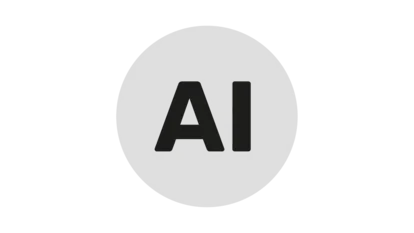
AI Icon
This content was created using AI.
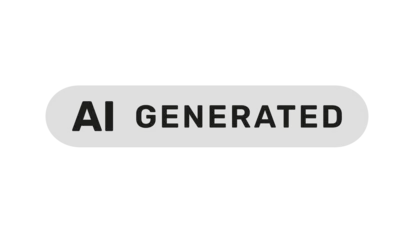
AI generated
Content fully generated by AI.
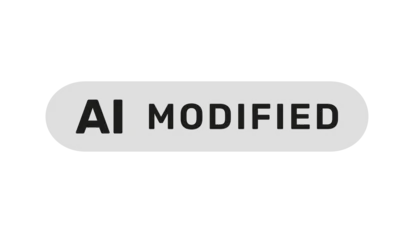
AI modified
Teilweise von AI-modifizierter Inhalt.
Important for the practical use of the EU AI icons: The icon must be permanently placed within the image or directly next to it, remain intact even after downloading or redistribution, appear in a sufficiently large size, and be accompanied by a text description and an appropriate alt text for accessibility.
Which texts should be labeled?
The labeling requirement under Article 50 applies to texts generated entirely by AI that were published without any human review.
An article pre-drafted by AI but whose content was reviewed and approved during final editing does not need to be labeled. The same applies to texts written by humans and subsequently improved by AI in terms of style or through spell-checking.
Special Case: Chatbots
Article 50 (1) requires that users of an interactive AI system (e.g., a customer service chatbot) be able to recognize from the outset that they are communicating with an AI.
Display of the Disclosure in the Front End
he following applies to placement: The disclosure must be inseparably linked to the respective content; it must not merely appear in a central location on the website, such as in the legal notice or the page footer. The statutory text requires that the AI-generated portion be clearly recognizable no later than when the content is first viewed and be distinguishable from the rest of the content.
Implementing the Labeling Requirement with TYPO3
Detecting AI Image Metadata
Three different metadata fields have now become standard for images, in which information regarding AI status can be stored: (IPTC DigitalSourceType, XMP Iptc4xmpExt:DigitalSourceType, and optionally a C2PA manifest.)
Ideally, this information could be read and stored in the database when image data is uploaded to the TYPO3 FAL. A suitable field for the FAL is currently being integrated.
AI Tagging of Media Directly in the FAL
The core patch Gerrit-Change 95172 adds a field to the FAL’s file metadata to indicate a file’s AI status. In a dropdown field, the editor can select the appropriate status—“general,” “generated,” or “modified” in addition to the empty default value.
A ViewHelper <f:aiContentLabel> then displays the corresponding indicator icon next to the image in the frontend. The advantage of this solution is that the information is directly linked to the media item itself and is thus automatically displayed correctly every time it is used.
The patch will be released in TYPO3 version 14.3; a backport is also planned for version 13.4.
AI Label Extension
The AI Label extension extension by b13 goes a step further: In addition to files, it also covers pages and content elements; it adds an “AI Metadata” tab with AI origin and a verification checkbox (which automatically resets when the content is edited again); and it offers its own backend module with an editorial-wide overview.
Editorial teams with a primary focus on visual content should be able to get by with the streamlined core patch. Larger editorial teams that regularly create AI-generated text and require a documented approval process should consider implementing the AI Label extension.
In both cases, the legal classification in each individual instance remains an editorial decision that the software merely supports.
Image credit output is supplemented by the PictureCredits extension
For our own PictureCredits extension for recording and displaying image credits in TYPO3, we will soon include the new field for AI status in the output. However, based on the current state of EU law, the label at the bottom of the page—where our extension displays image credits by default—will not be sufficient. An additional label is also required directly in or on the image itself.
Image credit output will be supplemented by the PictureCredits extension
For our own picturecredit extension for recording and displaying image credits in TYPO3 we will soon include the new field for AI status in the output. However, based on the current state of EU law, the label at the bottom of the page, where our extension displays image credits by default, will not be sufficient. An additional label is also required directly in or on the image itself.
Conclusion: Start linking content directly to the AI attribute now
At the moment, there is still some uncertainty regarding the labeling requirement and, in particular, its specific implementation in website design. However, it makes sense to start as soon as possible by clearly linking AI content to the AI attribute in the backend.
A purely editorial label within the page context carries the long-term risk that the required labels could be lost during upgrades or data migrations. However, if the AI status is directly linked to the content in the backend, the display of the label in the frontend can still be adapted at any time via the templates to reflect the current best practices.
Please feel free to share this article.
Comments
No comments yet.